(208) 336-3666
AERODYNAMICS STUDY
Even the Wind Can't Resist a Trinity Trailer
Is a Trinity trailer more or less aerodynamic than a conventional, square-sided competitor’s trailer?
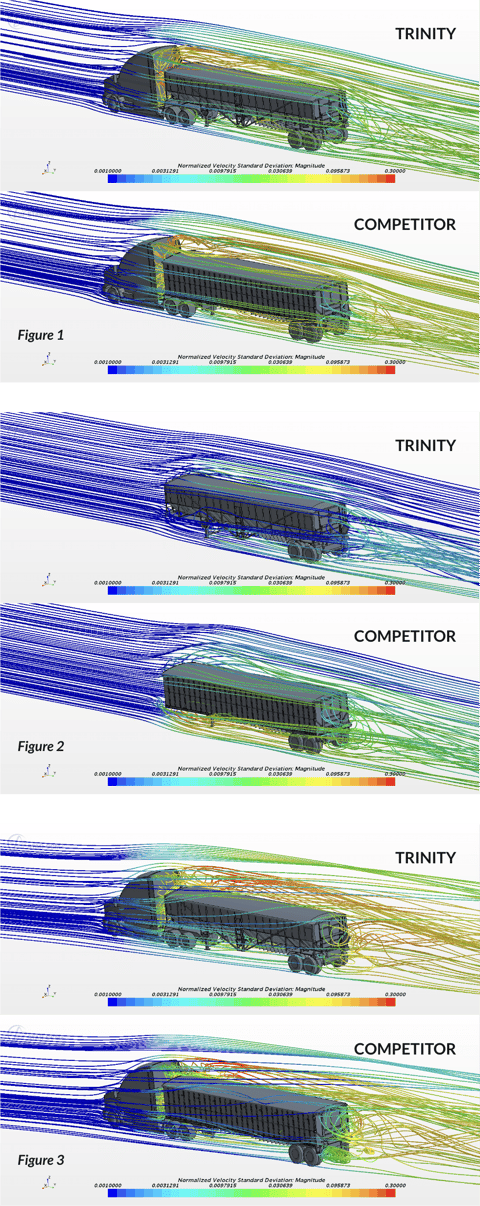
In order to provide the answer once and for all, Trinity employed the services of a major U.S. mechanical and aerospace engineering service provider. This company utilized sophisticated CFD (Computational Fluid Dynamics) tools to analyze the Trinity EAGLE BRIDGE® belt trailer design compared to other traditional belt trailers. In all cases the Trinity aerodynamic trailer performed as well or better in direct comparisons.
Three Simulations Were Performed
In our model comparison; being pulled by a tractor with a full wind fairing over the cab, no significant differences in aerodynamic properties were measured. In this 65 mph test it was determined that the major factor in wind resistance is the type of tractor unit and the aerodynamic properties of the tractor.
-
Tractor and Trailer combination at 65 mph, no crosswind (Figure 1)
-
Trailer only at 65 mph, no crosswind (Figure 2)
-
Tractor and Trailer at 65 mph with a 15° crosswind (Figure 3)
In the second and third simulations, the trailer only and tractor-trailer combination with a crosswind, the Trinity unit had proven to have significantly less wind resistance. This resulted from the aerodynamic shape of the Trinity trailer as opposed to a square structure of a competitor’s trailer being forced through the air. It was also analyzed and conclusively determined that the exoskeleton of the Trinity trailer has little to no effect on the overall aerodynamics of the unit, and the narrower frontal and side profiles of the Trinity trailer prove by extensive computer modeling and simulation to have less wind resistance than a traditional square sided trailer design.
So What Does That All Really Mean?
Trinity trailers have less wind resistance than a traditional trailer.
That translates to direct cost savings for you!